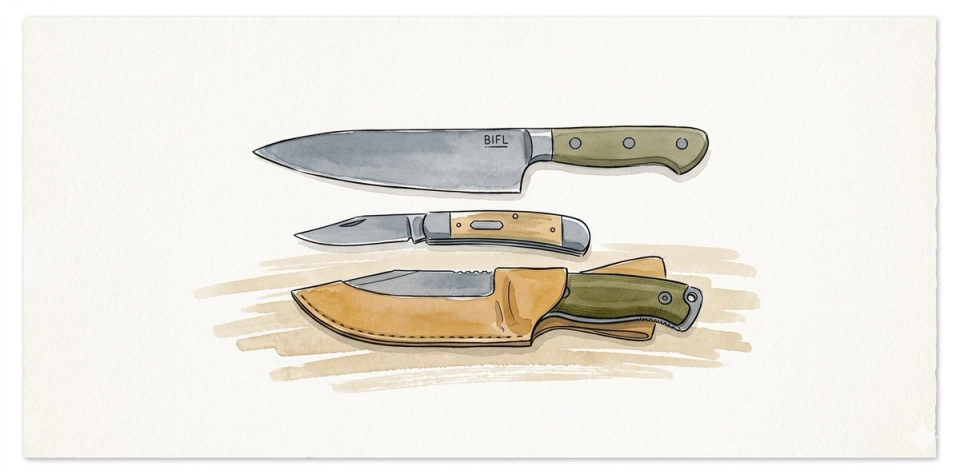
A BIFL knife is not just one purchase - it depends entirely on what you are cutting. Kitchen knives, pocket knives, and outdoor fixed blades are different tools for different jobs. This guide helps you decide which type you need and what to look for in each category.
Three categories, three decisions
Before choosing a knife, decide which problem you are solving. Most people need one knife from at least two of these categories:
- Kitchen knife - for daily food preparation
- Pocket knife (EDC) - for everyday carry and general tasks
- Outdoor/fixed blade - for camping, hiking, and bushcraft
Buying the wrong type - or expecting one knife to cover all three - is the most common mistake.
Kitchen knives
In the kitchen, one good chef's knife handles 90% of tasks. You do not need a knife block with eight pieces. You need one well-made knife that you keep sharp.
What makes a kitchen knife BIFL
- Full tang construction - the blade extends through the entire handle
- High-carbon stainless steel - holds an edge, resists corrosion
- Comfortable, durable handle - wood, composite or polypropylene
- A brand that sells replacement parts and supports long-term ownership
Recommended starting points
The Victorinox Fibrox Pro is the most recommended entry-level BIFL chef's knife. It is used in professional kitchens, holds an edge well, and costs a fraction of German or Japanese alternatives. Wusthof and Zwilling are the reliable step-up options for those who want forged German steel.
Pocket knives (EDC)
A good pocket knife is one of the most useful everyday carry items you can own. The key is matching the knife to how you actually use it.
Slip joint vs locking blade
Slip joint knives (like the Opinel) have a blade held open by spring tension - no lock. They are legal in more places and lighter, but less suitable for tasks requiring firm, one-handed grip. Locking blades (liner lock, frame lock) are more secure for harder tasks but may be restricted in some countries.
What to look for
- Carbon or stainless steel blade - both have trade-offs (carbon: sharper edge, needs oiling; stainless: lower maintenance)
- Simple mechanism - fewer parts means fewer things to break
- Reputable blade steel - look for established steels like 12C27, VG-10, or similar
- Replaceable or sharpenable blade - avoid proprietary systems
Outdoor and fixed-blade knives
A fixed-blade knife is stronger, easier to clean, and more reliable in the field than a folding knife. If you camp, hike, or spend time in the outdoors regularly, a fixed blade is worth carrying.
What to look for
- Full tang construction - critical for a working outdoor knife
- Scandinavian grind (scandi grind) - easy to sharpen in the field
- High-carbon steel - holds a better working edge than stainless
- Simple sheath - Kydex or leather, secures the knife safely
- Appropriate size - 90–110mm blade handles most outdoor tasks
Sharpening: the skill that makes knives last
A BIFL knife is only as good as the edge you maintain on it. Learning to sharpen is not optional - it is the difference between a knife that performs for decades and one that sits in a drawer unused.
- A whetstone (1000/3000 grit) is the best long-term investment - €20–40
- A leather strop maintains the edge between sharpenings
- Pull-through sharpeners are convenient but remove too much metal over time
- Electric sharpeners are fast but imprecise - not recommended for quality knives
Ten minutes on a whetstone every few months will keep a quality kitchen knife in better condition than factory-fresh indefinitely.