Why automatic watches outlast quartz
A quartz watch is more accurate than a mechanical one. It has a fixed lifespan. The battery needs replacing every 1–3 years, the crystal oscillator degrades over decades, and when the movement eventually fails the economics rarely justify repair. Quartz watches are consumer electronics with a horological face.
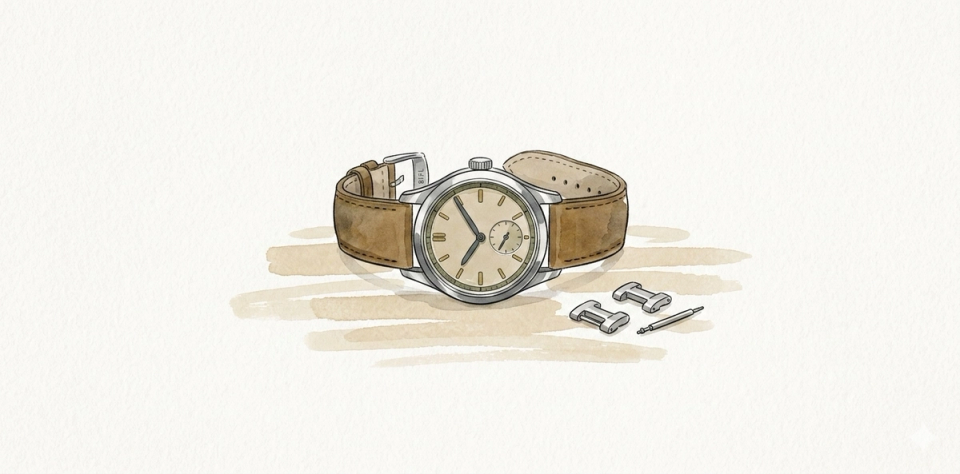
An automatic watch is powered by the motion of your wrist. It has no battery. The movement is entirely mechanical (springs, gears, levers) and can be disassembled, cleaned, lubricated, and reassembled by a watchmaker indefinitely. Watches from the 1940s and 1950s are still running today because someone services them every decade or so. That is the proposition: a correctly chosen automatic watch is the last watch you will ever need to buy.
What to look for: movement simplicity
The single most important factor in long-term serviceability is movement simplicity. A three-hand watch (hours, minutes, seconds) with a date complication is significantly easier and cheaper to service than a watch with chronograph, moon phase, or annual calendar complications. Fewer parts means fewer points of failure and a larger pool of watchmakers qualified to service it.
The ETA 2824-2 and Sellita SW200 movements (found in mid-range Swiss watches from Tissot, Hamilton, and others) are among the most widely serviced movements in the world. Any competent watchmaker can work on them.
Sapphire vs mineral crystal: the practical difference
Mineral crystal scratches. Sapphire crystal does not, at least not in normal use. Sapphire rates 9 on the Mohs hardness scale; only diamond (10) and certain ceramics scratch it. For a watch you intend to wear daily for decades, sapphire crystal is not a luxury: it is the practical choice.
Our picks
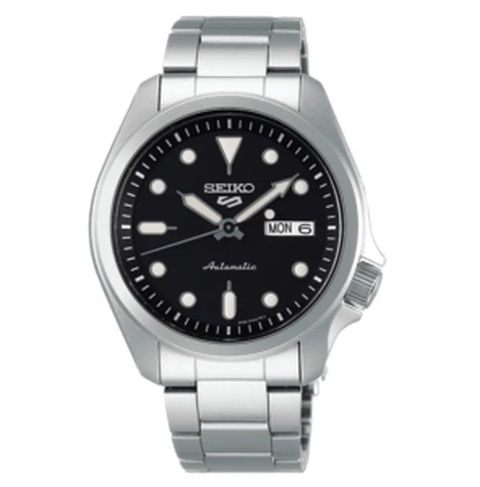
Seiko 5 Sports: Best entry point
At €150–180, the Seiko 5 Sports is the easiest argument against ever buying a quartz watch. Self-winding 4R36 movement, 100m water resistance, stainless steel case. The movement keeps time to ±15 seconds per day, entirely acceptable for a watch you actually wear. Seiko movements are serviced by watchmakers worldwide; parts are abundant and cheap.
Hamilton Khaki Field Mechanical: Best mid-range choice
The Hamilton Khaki Field Mechanical (€370–460) is hand-wound: you wind the crown each morning. That simplicity eliminates the rotor assembly and makes the movement even easier to service. The ETA 2801-2 inside is a Swiss workhorse that has been in production for decades. Sapphire crystal, 50m water resistance, military-influenced field watch aesthetic.
Tissot Le Locle: Best precision at this price
At €460–550, the Tissot Le Locle is the most refined watch on this list. The ETA 2824-2 movement is COSC-certified, meaning it keeps time to ±4 seconds per day, better than many watches costing ten times the price. Sapphire crystal, 30m water resistance, classic dress watch proportions.
Service intervals and total cost of ownership
A mechanical watch should be serviced every 5–8 years. Cost varies: a Seiko service runs €90–180; a Swiss movement service typically €140–270 at an independent watchmaker. Over 40 years, you are looking at 5–7 services.
Add that to the purchase price and compare it against replacing a smartwatch every 3–4 years. A €380 smartwatch replaced every 4 years costs €3,800 over 40 years and leaves nothing behind. A €500 Tissot Le Locle with €1,500 of lifetime servicing costs €2,000 and ends up on a grandchild's wrist.