Wood: the advantages and the upkeep
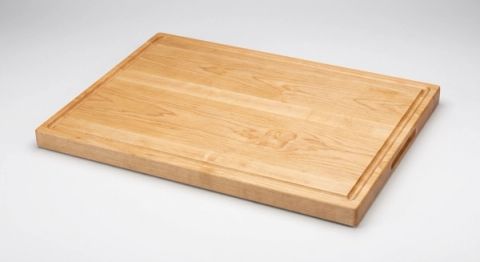
Wood is the traditional choice and for good reason. Hardwoods like maple and walnut are self-healing at the microscopic level, the wood fibres close around knife cuts rather than retaining them as permanent grooves. Those grooves on plastic boards are where bacteria accumulate and where cleaning becomes less effective over time. Wood is also significantly kinder to knife edges than plastic or glass. The trade-off is maintenance: a wooden board needs to be oiled with food-grade mineral oil every month or two, and it cannot go in the dishwasher. Water warps wood boards if they soak or are left wet.
Which wood, and what to avoid
Maple, walnut, and cherry are the hardwoods that come up again and again as the safe long-term choice. Budget at least $100 to $120 for a board that actually delivers on that promise. Cheaper hardwood boards are often cut thinner and warp more easily.
Bamboo is marketed as the sustainable option, but bamboo is grass, not wood. It carries natural silica and a Janka hardness around 3000, well above maple's roughly 1400. That hardness dulls knives faster, and cracking complaints show up more often with bamboo than with solid hardwood.
Plastic doesn't solve the knife problem as cleanly as it looks: cutting on it sheds microplastics that end up in your food. Glass, titanium, and slate are worse still for your knife edge. Pick one of those only if you're fine with a dull blade.
End grain vs face grain
An end-grain board (where the cut surface is the ends of the wood fibres, like a cross-section of a log) is more self-healing and gentler on knives than a face-grain board (where the cut surface is the flat side of the wood). End-grain boards are heavier, more expensive, and require more care. Face-grain boards are lighter, cheaper, and still significantly better than plastic for knife maintenance. For most home cooks, a good face-grain hardwood board is the practical choice.
Not everyone agrees on this. Some board makers argue face grain is the better choice for a home kitchen: fewer glue seams mean less risk of the board splitting, it needs less oil, and it warps less. Some cooks go further and say the honing routine matters more for knife sharpness than end grain versus face grain ever will.
Plastic: better than its reputation for the right uses
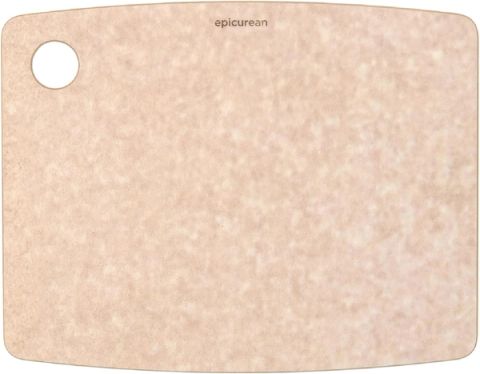
A plastic board like the Epicurean board (made from compressed paper, technically) is light, dishwasher-safe, and good for raw meat, you can throw it in a hot dishwasher cycle and actually sanitise it. The material is harder than wood and slightly harder on knife edges. Over years of use, deep grooves form that are impossible to clean effectively, and at that point the board should be replaced. But "at that point" for a good plastic board is 3-5 years, not 6 months. If you have one board and want something low-maintenance, a quality plastic board is a reasonable choice.
Buy from a local maker
The advice that comes up most often among people who have owned the same board for years is simple: buy from a woodworker instead of a retailer. Craft fairs, maker markets, and platforms like Etsy are full of hobbyists selling boards at close to material cost that hold up just as well as the well-known brands.
Cult brands like The Boardsmith and John Boos are popular in the US, and John Boos in particular is widely available through Amazon. Outside the US, a local maker or a regional supplier is often the more practical route: no import wait, no shipping cost on a heavy item, and you can see and handle the board before paying. The advice on wood type, thickness, and maintenance doesn't change, only where you buy it.
Maintenance schedule
Never in the dishwasher, never soaking in the sink. Dry it right after use and store it standing up, not flat against a wet counter.
A simple rhythm works best for oiling: every day for the first week, every week for the first month, every month for the first year, then once a year after that. Food-grade mineral oil is enough. The cheap bottle sold at a pharmacy as a laxative is the same product as the pricier bottle labelled 'cutting board oil'. Sanding is rarely needed for normal home use.
Cutting board materials compared
| Material | Knife-friendliness | Maintenance | Typical lifespan |
|---|---|---|---|
| End grain hardwood (maple, walnut, cherry) | Very good | Oil monthly | 20+ years |
| Face/edge grain hardwood | Good | Oil monthly | 15-20 years |
| Teak | Good | Needs oiling less often | 15-20 years |
| Rubber composite (e.g. Hasegawa) | Excellent | Minimal upkeep | 10+ years |
| Plastic composite (e.g. Epicurean) | Decent | Dishwasher safe | 3-5 years |
| Bamboo | Fair to poor | Low upkeep, crack-prone | 2-5 years |
| Glass / titanium / slate | Poor | No upkeep needed | Effectively unlimited, not recommended |
The practical recommendation
Most serious home cooks have two boards: a large wooden board for most cooking tasks (vegetables, bread, cooked meat) and a smaller plastic board for raw meat and fish. The wooden board gets oiled regularly and lives on the counter. The plastic board goes in the dishwasher after every use involving raw protein. This setup covers every situation without needing a specialty board for every task.
Bottom line
Your knife is the item built to last a lifetime. Your cutting board is the surface that takes the wear, closer to a set of tires than to the knife itself: a good one earns its price, and replacing it eventually isn't a failure.
Best overall: end grain maple or walnut, at least 1.25 to 1.5 inches thick, as large as your counter allows and as heavy as you can comfortably lift. Ideally from a local maker.
Best low-maintenance: the Epicurean board above, if you'd rather skip the oiling and still keep your knives sharp.
Best for expensive knives: a rubber composite board such as Hasegawa. Rubber is gentler on an edge than even top-tier hardwood, though that specific brand can be hard to find outside the US.