French design since 1890
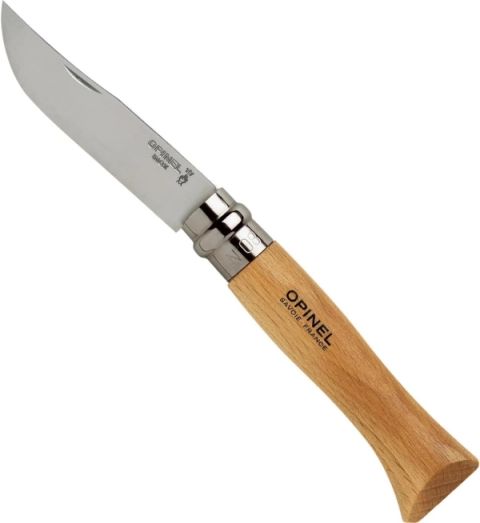
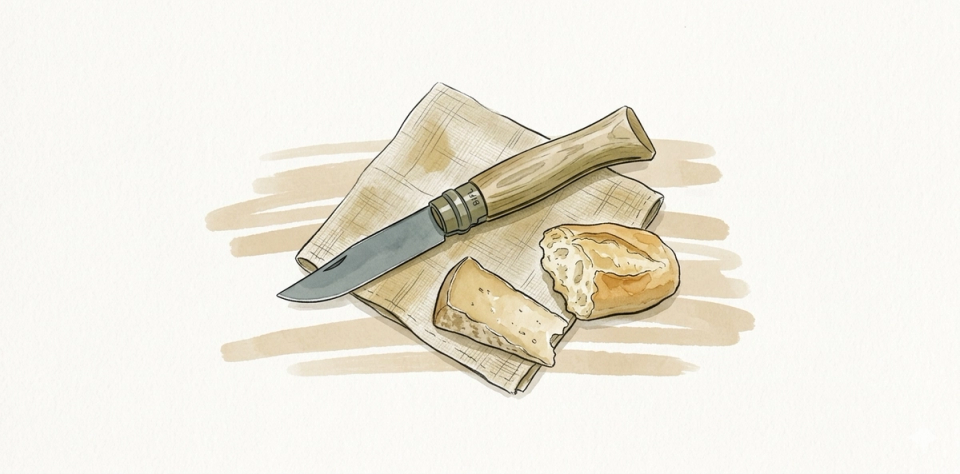
Joseph Opinel started making pocket knives in Savoie, France in 1890. The design he developed - a simple wooden handle with a blade that pivots on a pin, locked with a rotating collar - has not fundamentally changed. The Victoria and Albert Museum in London has an Opinel in its permanent collection as an example of well-designed everyday objects. That sounds like marketing, but it is also just accurate. The knife is elegant, functional, and cheap.
The No. 8 as the right size
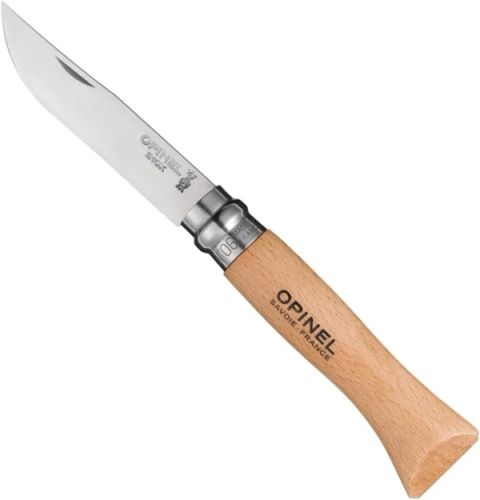
Opinel makes knives in numbered sizes from No. 2 (tiny, almost toylike) to No. 13 (large enough to be impractical for most uses). The No. 8, with an 8.5cm blade, is the one most people settle on: large enough to be genuinely useful for camping, picnics, and food prep, small enough to fit in a pocket. The No. 6 is the right choice if you want something smaller and more discreet. Most outdoor enthusiasts who own an Opinel own a No. 8.
Carbon steel vs stainless
Opinel offers both. Carbon steel (12C27 grade, labelled with a black ring) takes a sharper edge and is easier to sharpen, but will rust if left wet or stored damp. You need to oil the blade occasionally and dry it after use. Stainless steel (12C27 Sandvik, labelled with a silver ring) is more forgiving - you can leave it in your pack without worrying about rust, and it stays sharp for longer between sharpenings, but it is harder to get back to a keen edge when it does dull. For camping where you will be using it daily: carbon. For occasional use where it will sit in a drawer: stainless.
Virobloc and sharpening
The Virobloc is Opinel's rotating collar lock, added in 1955. Rotate it one direction to lock the blade open; rotate the other way to lock it closed (useful for carrying). It is simple and works reliably. If the wooden handle swells from moisture and the blade becomes hard to open, leave the knife in a dry place for a day and the wood will contract. Sharpening is straightforward: the thin Scandinavian-style grind responds well to a flat whetstone or even a piece of sandpaper on a flat surface.