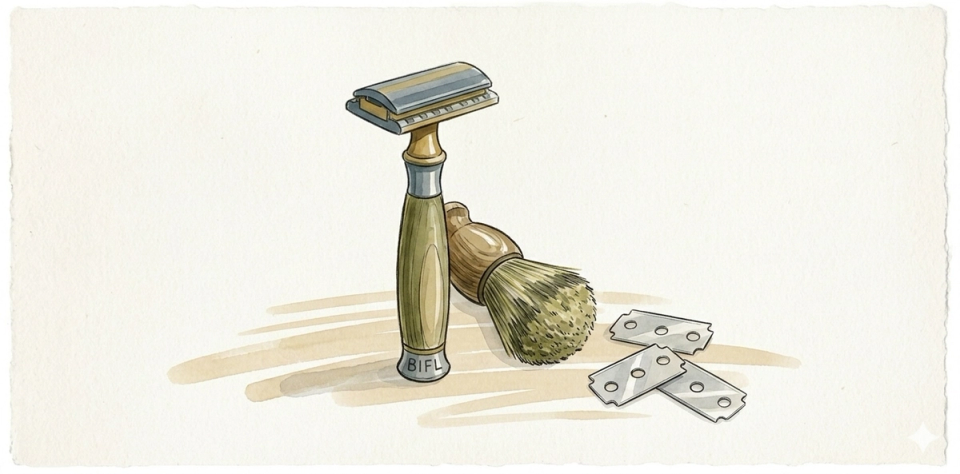
A safety razor is one of the few purchases where switching costs less, shaves better, and lasts a lifetime. This guide covers everything you need to start shaving with a double-edge razor - including what to buy, how to use it, and why it outlasts any cartridge system.
Why switch to a safety razor
Cartridge razors are designed to be replaced. Blades dull quickly, refills are expensive, and the plastic handle ends up in landfill. A double-edge safety razor flips this model entirely.
- Blades cost 10–30 cents each - versus €3–5 per cartridge
- The handle lasts decades with basic care
- Less plastic waste - blades are recyclable steel
- A closer shave with less irritation once you learn the technique
- The shaving ritual slows you down - many users find it genuinely enjoyable
The learning curve is real but short. Most people dial in their technique within two weeks.
Choosing your first razor
For beginners, a mild, balanced razor is the right starting point. Avoid aggressive open-comb models until you have the technique down.
What to look for
- Closed comb (not open comb) - more forgiving for beginners
- Medium weight - too light requires more pressure, too heavy is harder to control
- Three-piece construction - easiest to clean and maintain
- Reputable brand - blade alignment matters for safety and performance
Recommended starter razors
The Merkur 34C Heavy Duty is the most recommended beginner razor worldwide. It is forgiving, well-balanced, and available everywhere. The Edwin Jagger DE89 is a lighter alternative with the same mild geometry.
Blades: the part most beginners overlook
The handle is almost irrelevant compared to the blade. Different blades behave very differently depending on your skin, hair type, and technique. This is called the blade/face matching problem.
How to find your blade
- Buy a blade sampler pack - typically 30–50 blades from 10–15 brands for around €10
- Try each blade for at least 3 shaves before judging
- Note which blades feel smooth and which tug or irritate
- Once you find your blade, buy in bulk - 100 blades typically cost €8–15
Popular beginner-friendly blades: Astra Superior Platinum, Feather (sharp, less forgiving), Gillette Silver Blue.
Technique: the three fundamentals
Most irritation and cuts in DE shaving come from technique errors, not from the razor itself.
1. Angle
Hold the handle roughly parallel to your face - about 30 degrees from the skin. The cap (top of the head) should rest lightly on your face while the blade makes contact. Never apply the blade edge-first.
2. Pressure
Use no pressure. Let the weight of the razor do the work. The most common beginner mistake is pressing down as you would with a cartridge razor. On a DE razor, this causes cuts and irritation.
3. Passes
Start with two passes: one with the grain (the direction the hair grows), one across the grain. Add a third against-the-grain pass only once your technique is dialled in. Always re-lather between passes.
Shaving prep and products
Preparation matters more with a safety razor than with a cartridge. The blade has no lubricating strip and no pivoting head to compensate for poor prep.
- Shower first, or wash your face with warm water - softens the hair
- Use a proper shaving soap or cream with a brush - builds a better lather than foam cans
- Lather in circular motions to lift the hair off the skin
- A good alum block or witch hazel closes pores and soothes irritation after the shave
Blade disposal and maintenance
Used blades should go in a blade bank - a small metal tin with a slot that you seal and recycle when full. Never put loose blades in the bin.
After each shave: rinse the razor, shake off excess water, and leave it disassembled on a towel to air dry. Once a week, rinse with hot water. No oil needed.
What to expect in the first two weeks
The first few shaves will likely be imperfect. You may get some minor weepers (tiny cuts) as you learn the angle and pressure. This is normal. Resist the urge to press harder - it makes things worse.
By the end of week two, most people are shaving as fast as with a cartridge and getting noticeably better results. By week four, the routine is second nature.