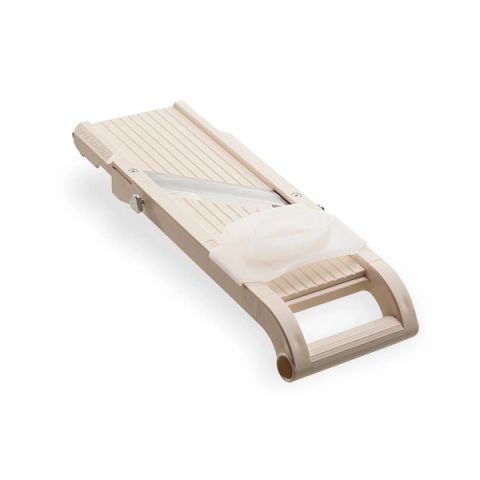
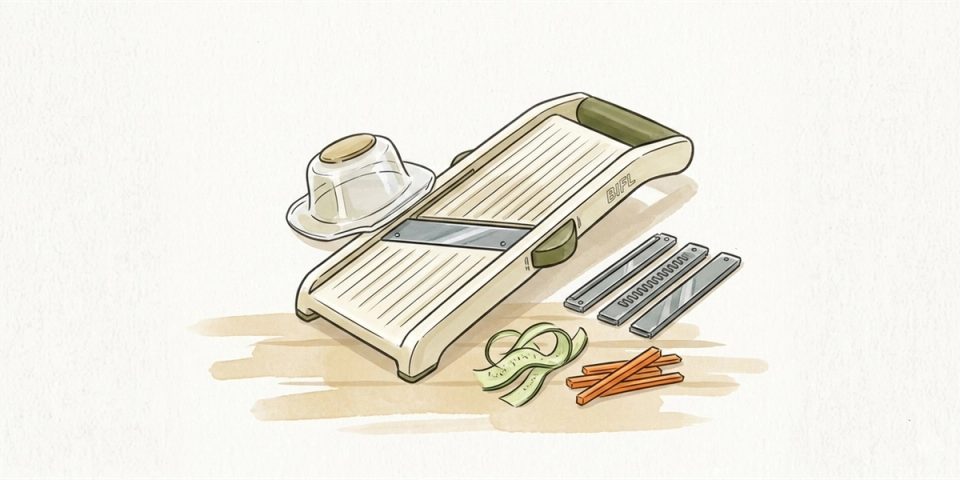
The Super Benriner No. 95 sits in the same professional line as the classic No. 64, but it is clearly built for more room. The cutting width is 95 mm, thickness adjusts from 0.5 to 8.0 mm, and the body still feels simple enough to keep for years. My expectation going in: a reliable mandoline that could handle harder and wider vegetables. What I found: a sharp tool that earns respect immediately, provided you take safety seriously.
Build and materials
The body is food-safe ABS plastic, ivory in color. That sounds less impressive than full stainless construction, but in practice it does not matter. The body is solid, lightweight, and easy to clean. The blade is stainless steel, pressed and heat-treated, hand-finished in Japan. The sharpness is noticeable from the first cut.
The blade measures 95 mm wide. That is the main difference versus the No. 64: kohlrabi, beet, zucchini, cucumber, fennel, and larger potatoes fit under the blade more easily. For very wide produce, like half a cabbage or a large melon, the 120 mm Jumbo still makes more sense. For home use, 95 mm feels like the more useful middle ground.
Thickness is continuously adjustable via a dial, from 0.5 mm to 8.0 mm. No fixed steps, no click positions. You set what you need and the blade follows. That higher upper limit makes the No. 95 more practical for thicker slices than the smaller No. 64.
Blades and versatility
Included are four blades: the flat blade for standard slicing, and three julienne blades for fine, medium, and coarse cuts. The coarse insert is more useful than on the No. 64, making fry-like strips more realistic. Blades swap with the side clamps, and replacement blades are sold separately through specialty kitchen shops.
The julienne blades perform well on soft and semi-firm vegetables: zucchini, cucumber, daikon, carrot on thinner settings. On hard vegetables like sweet potato or thick winter carrots, they require more force, and the manufacturer warns about this. On Reddit, u/sausagemuffn confirms this honestly: "Slicing's not a problem but julienne still takes a lot of force, especially with thick monster carrots."
My first test: kohlrabi
The box sets the tone quickly. The frame has a "watch your fingers" warning, the manual and box put "Safety Precautions" in bright red, and the user-review advice to order a cut-resistant glove starts to sound less dramatic once the tool is in front of you. So far I only use it with the included finger guard. The spare julienne blades also come in a sturdy case that is not easy for small children to open.
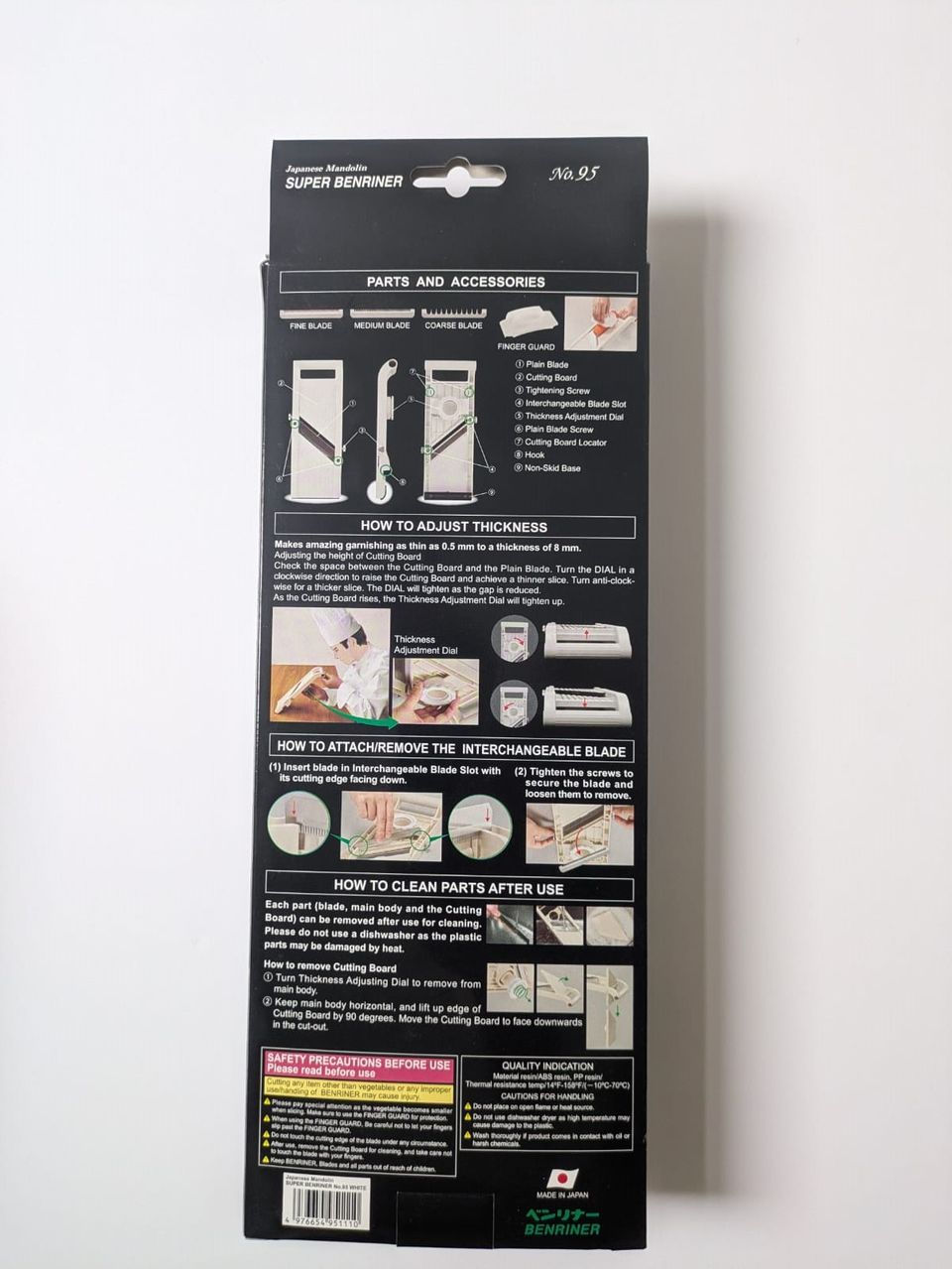
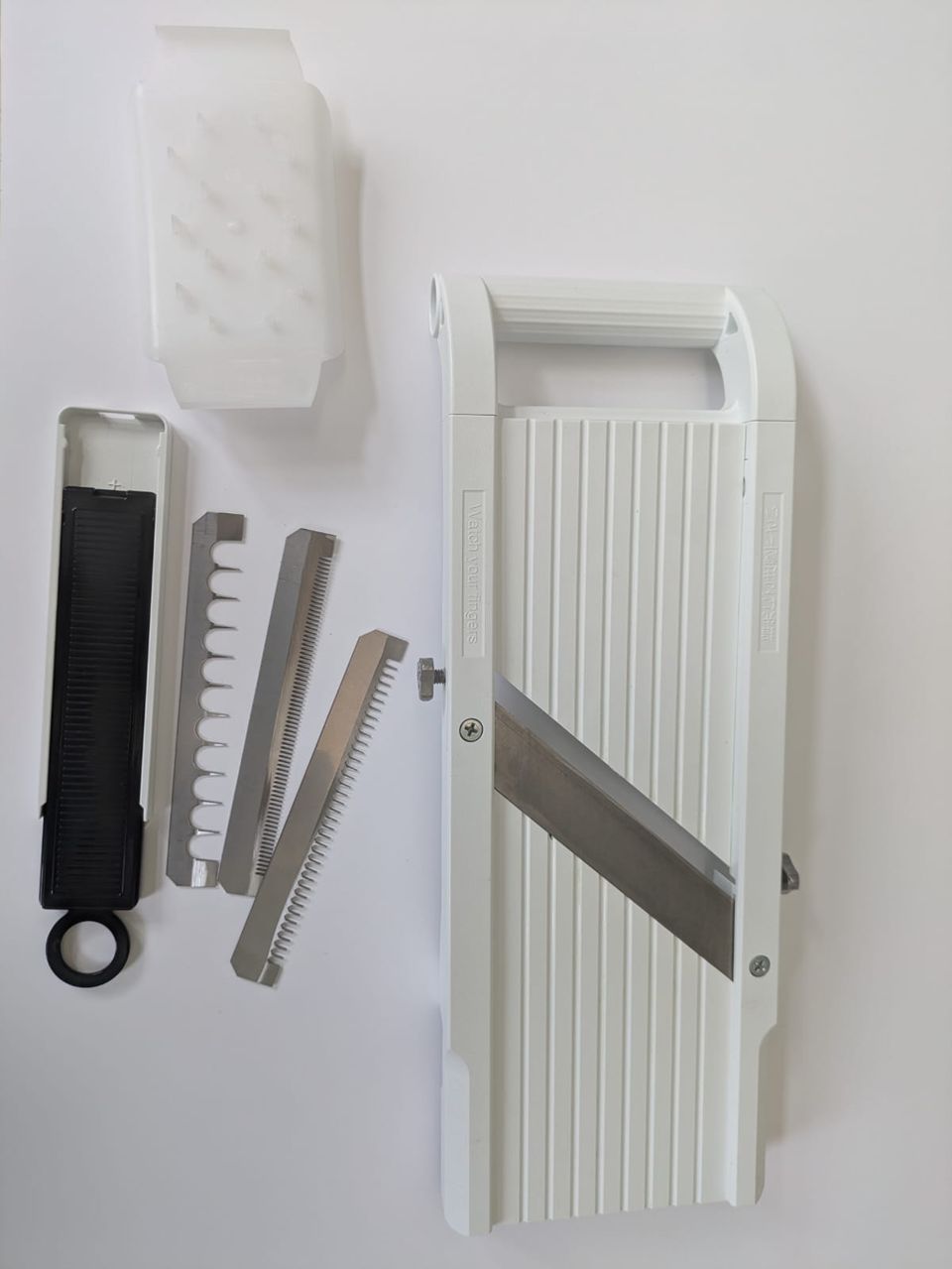
For a first test I used a fairly hard kohlrabi. The flat blade made clean slices at two thicknesses, and the medium julienne insert cut fine strips without tearing the vegetable apart. Swapping blades and changing thickness is easy. The actual learning curve is choosing the right setting and finding the safest way to hold and move the produce.
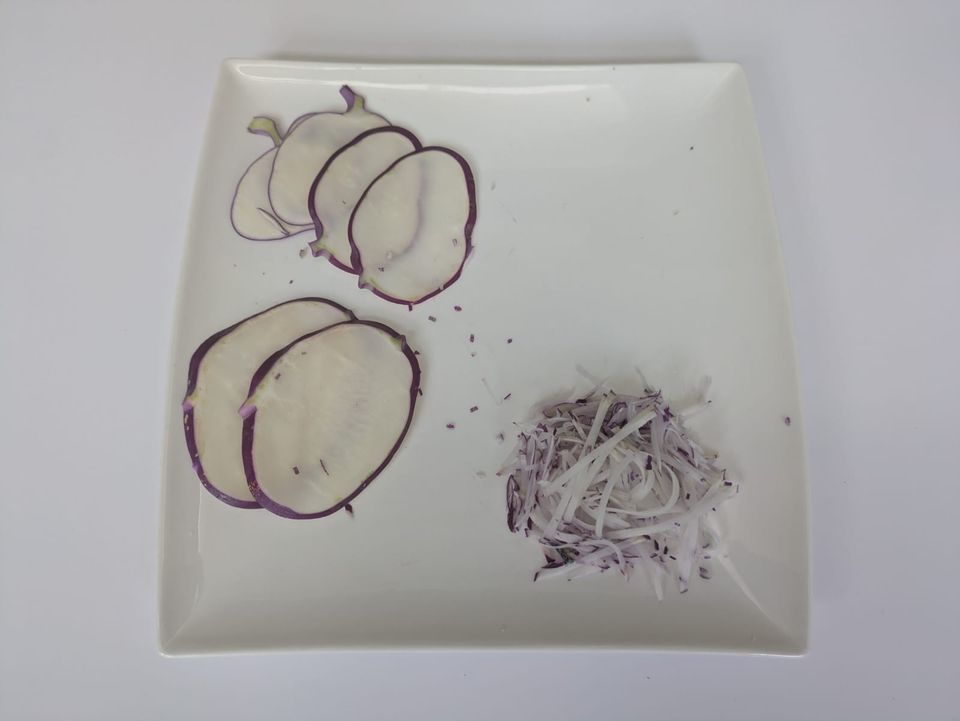
I was also worried about beetroot staining the white board. The color did not soak in at all, which is a small but useful reassurance with an ivory plastic body.
Sharpness and longevity
This is where the Benriner earns its reputation. America's Test Kitchen ranked it at the top of its class for blade sharpness. Users confirm this holds up over years of use. On Reddit, u/PeachJumpy writes: "Super sharp. Have had mine for 15 years. Simple design is quick to clean."
The blade can be honed or replaced over time. A replacement blade costs a fraction of the original purchase price and is widely available. This is what separates the Benriner from budget mandolines: with a cheap slicer, you replace the whole unit. With the Benriner, you replace the blade if it ever needs it.
Over ten years, a 15-dollar mandoline that fails every two years costs at least 75 dollars plus the hassle of replacement. The Super Benriner No. 95 costs noticeably more than the No. 64, but you are buying a wider, more capable model with replaceable blades. The math works best if you use it often.
Safety: an honest note
The included finger guard is useful, but it does not remove the risk, particularly as produce gets shorter. This is the most consistent practical warning across user reviews and Reddit discussions. u/Rich_Season_2593 is direct about it: "BUY a cut glove to save your fingers - the blade is crazy sharp. Highly recommend Benriner."
A cut-resistant glove (level 5, typically 10 to 15 dollars) is not a gimmick. Budget for it as part of the purchase if you plan to use the mandoline often. I have only used the Benriner with the supplied finger guard so far, and I would not use it casually without some form of hand protection.
On the other side, u/spellbunny from r/JapaneseFood puts the overall experience in perspective: "I bought a Japanese 'Benriner' mandolin a couple years ago and it has upgraded my cooking game by miles and miles!!"
Day-to-day use and storage
The mandoline hooks over a mixing bowl via a notch on the frame, stands on rubber non-slip feet, and at roughly 36.5 cm is longer and wider than the No. 64. It still fits in a cabinet, but not automatically in every kitchen drawer. No loose parts, no complicated assembly. Setup takes about ten seconds.
The Benriner should not go in the dishwasher. That is a downside, but I notice that the few tools I wash by hand somehow get treated with more care. For a deeper clean, the whole tool can come apart. The finger guard takes the most attention, because food can lodge in the corners.
How it compares
The OXO Good Grips mandoline scores better on safety ease of use, thanks to its spring-loaded hand guard and clearly marked thickness dial. For cooks who prioritize safety features over raw blade performance and longevity, the OXO is a serious alternative.
The Kyocera ceramic mandoline holds an edge for a long time between sharpenings, but offers no julienne function and has a narrower cutting surface. Not a full competitor.
Budget mandolines in the 10 to 20 dollar range are temporary solutions. They cut less precisely, wear out faster, and cost more over time.
Conclusion
The Super Benriner No. 95 is a sound purchase for anyone who slices vegetables regularly and deliberately wants more width than the No. 64 provides. The blade is sharp, the design stays simple, and replacement blades are available when you eventually need them. The finger guard requires attention and hand washing is mandatory. Buy a cut-resistant glove at the same time. With that, you have a tool you should not need to replace quickly.