What I Expect From a Duffel Bag
When I spend $160 on a bag, I expect it to outlast two or three cheaper bags. Coatings should stay on the fabric. Warranties should hold up when something actually goes wrong. Shoulder straps shouldn't fail on the first airport run. The Patagonia Black Hole Duffel has a strong reputation in BIFL circles. After extended use and reading through hundreds of owner reports, my take is more nuanced than the typical gear review you'll find.
Materials: What You're Actually Buying
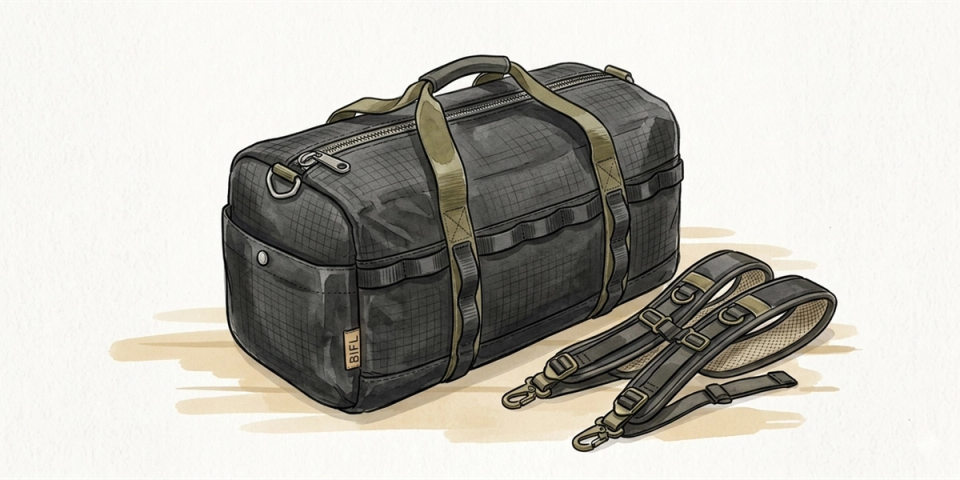
The outer shell is 900-denier recycled polyester ripstop bonded with a TPU (thermoplastic polyurethane) laminate. The 900D denier count is meaningfully thicker than what most budget travel bags use, and the TPU laminate is what makes the bag weather-resistant. Weather-resistant, not waterproof: the bag will handle a wet baggage carousel, rain walking to the car, or being left outside in a drizzle without soaking through. Submerge it or leave it in a downpour for an extended time and moisture will eventually get in.
The lining is 200-denier recycled polyester with a PU coating. Zippers throughout are YKK, the industry benchmark for durability and repairability. The base is padded to absorb impact from baggage handlers and hard floors.
The 2024+ version is made entirely from recycled materials, produced in a Fair Trade Certified factory, and Bluesign approved. It says something about how seriously Patagonia monitors production quality.
The Known Weak Point: Delamination
I won't skip over this. Older Black Hole Duffels, specifically the shiny/glossy versions sold through roughly 2023, had a real problem: the TPU laminate separated from the fabric along fold lines, in humid storage, or after sustained hard use. Photos circulating in gear forums show coating peeling off in strips. For a bag sold on its durability, that's a significant failure.
Patagonia addressed this in the 2024+ matte version. The matte surface bonds better; delamination reports on the new models are substantially fewer. But the issue isn't fully gone: there are reports of stitching separating near the shoulder strap buckle on 2024-2025 units, though these appear to be isolated rather than widespread.
The warranty handling for delamination has been inconsistent. Some owners received full replacements. Others were offered a discount on a new bag, or denied coverage because delamination was classified as normal wear rather than a manufacturing defect. If you ever file a claim, bring photos, be specific about when and how the problem appeared, and understand that outcomes vary. The Ironclad Guarantee is real, but its application isn't uniform.
How the Bag Performs Day to Day
The 40L fits as carry-on with most airlines, which makes it the size I'd recommend for trips up to a week. The 55L makes sense for longer travel or for people who simply pack more.
The convertible backpack function works, but it's not comfortable for more than an hour of walking. There's no hip belt, no frame, no chest strap. The carry handles on top also don't stow completely out of the way, so they can rub against your back or arm during backpack-mode use. Fine for getting from the taxi to the check-in desk; not appropriate for anything resembling a trek.
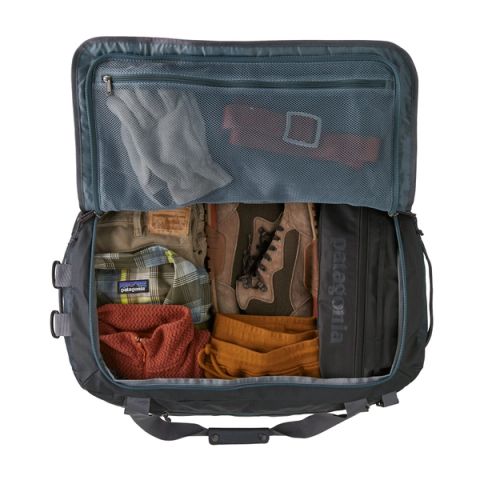
The interior is minimal: a mesh pocket inside the main compartment, a side pocket accessible from both inside and outside, and the padded base. Packing cubes are effectively mandatory if you want any organizational structure. The external daisy chains are useful for lashing extra gear to the outside.
Weight is 1045g (40L) and 1180g (55L). Not ultralight, but reasonable for a bag in this material class.
Expected Lifespan
Multiple owners report 10 years and longer without significant wear, provided the bag is stored correctly: not compressed for extended periods, kept dry between trips. Patagonia's own estimated lifespan is 7 to 15 years at normal use intensity.
Repairability is a genuine strength. YKK zippers can be replaced when they eventually wear out. Fabric tears can be patched with Patagonia's own patch kits. The Worn Wear program offers repair service. A broken zipper or a small puncture doesn't mean the bag's life is over.
Price and the Alternative
The 40L runs $149-$159 and the 55L $169-$179 at retail. That's on the high end for a soft duffel. Compare that to replacing a $60 bag every three years and the math looks different.
The Eagle Creek Cargo Hauler is the most credible cheaper alternative. The 40L costs around $89-$149 depending on where you buy it. It's made from 600-denier PU-coated polyester, which is lighter and less abrasion-resistant than the Black Hole's 900D, and it lacks the TPU laminate for weather resistance. What it does have is the Whatever Guarantee, which on paper is stronger than Patagonia's: user damage is explicitly covered. Eagle Creek estimates about 7 years of lifespan. The right pick for casual or light travelers. Patagonia wins on material strength and weather resistance; Eagle Creek wins on price and a clearer warranty scope.
The Bottom Line
The Patagonia Black Hole Duffel (2024+ matte version) is a bag that will last a decade or more with proper use. The 900D construction holds up, the YKK zippers can be replaced when they eventually wear out, and the convertible carry system is useful for travel without pretending to be a proper backpack.
The warranty is less consistent in practice than Patagonia's marketing implies. Buying an older glossy version secondhand comes with meaningful delamination risk. And the bag is only as good as the care you give it between trips: store it dry, don't compress it for months at a time, and actually use the patch kits if something small goes wrong.
It's a good fit if you want a weather-resistant, hard-wearing duffel that handles rough baggage and lasts through a decade of travel. It's not the bag for you if you're expecting warranty claims that always resolve without friction, or if you want something that actually works as a backpack.