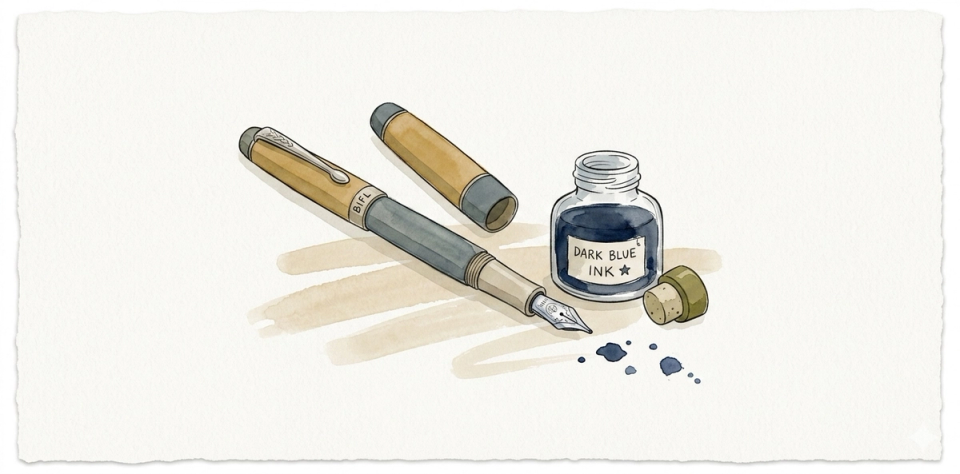
A fountain pen is the only writing instrument that improves the more you use it. The nib wears to fit your hand over time, the ink flow becomes familiar, and the ritual of writing slows you down in a way that most people find clarifying. This guide gets you started without overcomplicating it.
Why a fountain pen is a BIFL purchase
- A quality pen lasts decades - many people write with the same pen for 20–30 years
- Nibs can be replaced or reground by specialists if they wear unevenly
- Ink is refillable - no proprietary cartridges required (though cartridges exist for convenience)
- The writing experience improves - a broken-in nib writes smoother than a new one
- Entry-level pens cost €20–30 and perform well enough for daily writing
Choosing your first pen
The most important factor in your first fountain pen is that it works reliably and does not require fiddling. A pen that skips, blobbers, or hard-starts will kill your enthusiasm before you get started.
The Lamy Safari
The Lamy Safari is the most recommended beginner fountain pen, and for good reason. It is reliable out of the box, uses standard converters and cartridges, and the nib can be swapped in seconds if you want a different line width. It is made in Germany and built to last.
Nib sizes explained
- EF (Extra Fine) - very narrow line, good for small handwriting or note-taking
- F (Fine) - narrow line, popular for everyday writing in Western markets
- M (Medium) - standard line width, the most versatile starting point
- B (Broad) - wide line, shows off the ink's colour and shading well
Start with a Medium nib if you are unsure. It is the most forgiving and shows off ink well. Fine nibs require more precise technique.
Ink: where fountain pens get interesting
Choosing ink is one of the genuine pleasures of using a fountain pen. Unlike ballpoint pens, you have thousands of colours to choose from, and the same ink looks different in different pens.
Cartridge vs converter
Most fountain pens accept either cartridges (small plastic ink containers you snap in and discard) or a converter (a refillable piston mechanism you fill from a bottle). Cartridges are more convenient; converters are more economical and give you access to bottled inks.
Starter inks to try
- Pilot Iroshizuku - premium Japanese inks, beautiful colours, well-behaved
- Diamine - UK brand, huge colour range, affordable
- Lamy T52/T10 cartridges - reliable, available everywhere, good for travel
- Waterman Serenity Blue - the classic safe choice for everyday writing
Maintenance: simpler than you think
Fountain pens are less maintenance than most people expect. The basic rule: flush the pen with water when you change inks, and store it capped when not in use.
- Flush with room-temperature water when switching inks - run water through until it runs clear
- Store nib-up or horizontal - never nib-down for long periods
- If a pen sits unused for weeks, flush and re-ink before writing
- A pen that has dried out can almost always be revived with a long soak in water
Pairing your pen with the right notebook
Fountain pen ink is water-based and requires paper that does not bleed or feather. Cheap paper makes even a great pen look bad.
- Leuchtturm1917 - the most popular fountain pen-friendly notebook
- Rhodia - French paper brand, very smooth, loved by pen enthusiasts
- Clairefontaine - similar to Rhodia, excellent ink behaviour
- Midori MD - Japanese paper, slightly off-white, beautiful to write on
Your pen deserves a worthy notebook - read our comparison: Leuchtturm1917 vs Moleskine vs Rhodia