One knife, not six
The average home cook owns six knives and uses one. The bread knife, the paring knife, the carving set from a wedding gift: they sit in a block accumulating dust. One knife does all the work. If it is a cheap stamped blade, it spends most of its life dull.
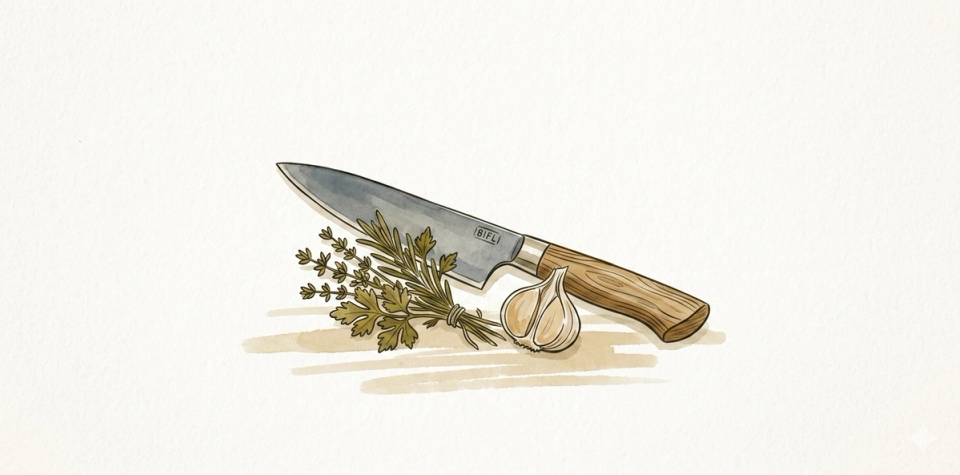
A sharp, well-balanced 20cm chef knife handles 95% of kitchen tasks. Chopping vegetables, slicing meat, breaking down a chicken. That is it.
Forged or stamped
Stamped blades are punched from a flat sheet of steel. Forged blades start as a steel bar, heated and hammered into shape, then heat-treated. Forging aligns the grain structure of the steel. The result is a harder, more resilient edge that holds sharpness longer.
The difference is visible: a forged knife has a bolster (the thick junction between blade and handle). Stamped knives have a uniform thickness from tip to heel. For a BIFL knife, forged is the right choice.
Steel hardness
Knife steel hardness is measured on the Rockwell C scale (HRC). German steel knives (Wüsthof, Henckels) are hardened to 58–60 HRC. Japanese knives (Global, MAC, Shun) run 60–67 HRC. Harder steel holds a sharper edge longer but chips under lateral stress. Softer German steel is tougher and easier to sharpen at home.
For a home kitchen, German steel at 58–60 HRC is the sensible choice. You can maintain it with a honing steel between uses and resharpen on a whetstone without specialist technique. Japanese steel at 62+ HRC rewards careful hands and proper whetstone work. Forgiving it is not.
The two knives worth buying
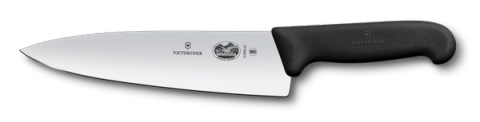
Victorinox Fibrox Pro 20cm
This is the knife in professional kitchens worldwide. At €35–50, not because chefs are cheap. It performs. The stamped blade takes a sharp edge easily. The Fibrox handle is NSF-certified, grippy wet, and nearly indestructible. Victorinox has made knives in Switzerland since 1884. Replacement handles are available. The knife can be resharpened indefinitely.
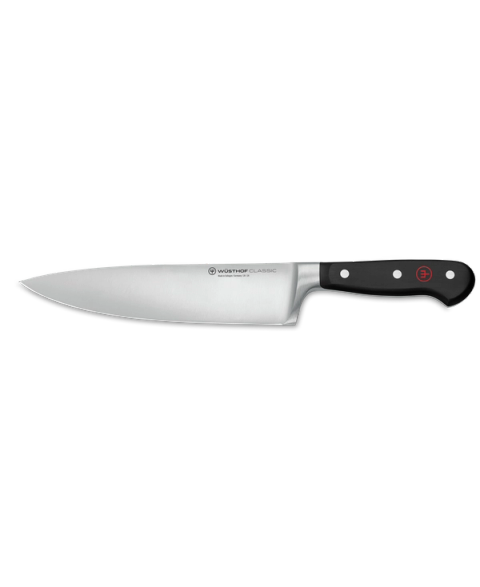
Wüsthof Classic 20cm
Wüsthof has been making forged knives in Solingen, Germany since 1814. The Classic 20cm is X50CrMoV15 steel, forged and hardened to 58 HRC, with a full tang and triple-riveted Polyoxymethylene handle. At €110–130 it is a deliberate investment. Wüsthof will sharpen and repair their knives: send it in, they restore it. Over 30 years of daily use, that is under €5 per year.
Sharpening: the maintenance that makes it BIFL
A knife that is never sharpened is dull within a year. Hone on a honing steel before each use: it takes 10 seconds and realigns the edge without removing metal. Sharpen on a whetstone every three to six months, or when honing no longer restores cutting performance.
Whetstones are the right tool. A 1000-grit stone handles reprofiling. A 3000–4000-grit stone refines the edge. Pull-through sharpeners remove too much metal and degrade the blade geometry over time. The whetstone takes practice. Worth learning.