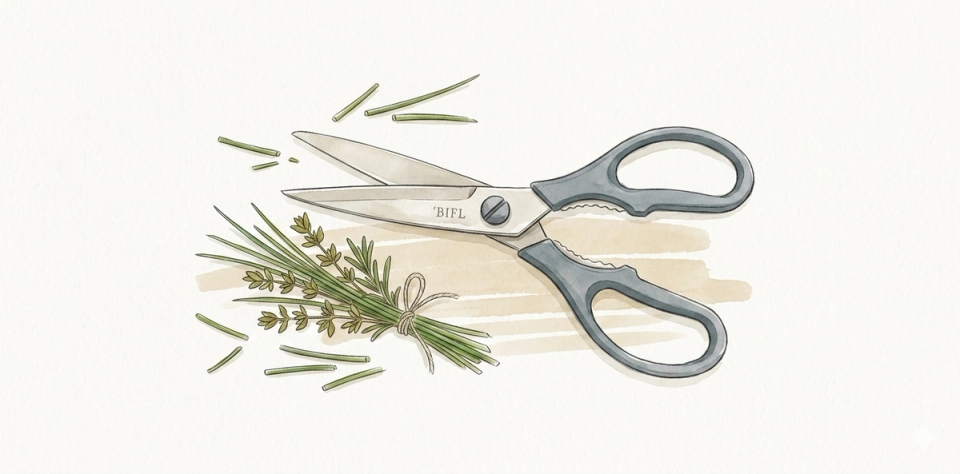
Why kitchen scissors matter more than most cooks realise
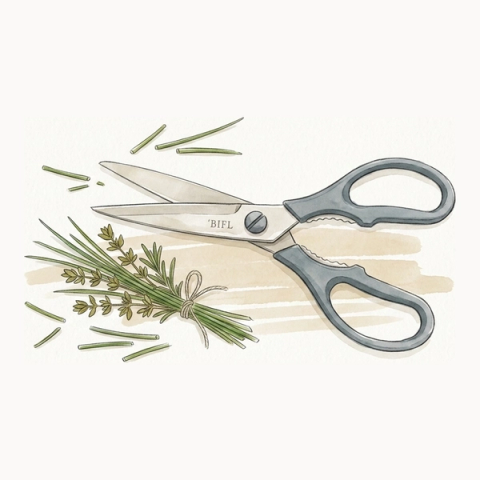
Kitchen scissors are the most underused tool in a home kitchen. They cut pizza faster than a wheel, break down poultry faster than a knife, snip herbs directly over a pan, and open packaging without pulling out a knife.
The problem is that most people buy cheap kitchen scissors once (€8 at a supermarket) and discover within eighteen months that the blades have separated, the pivot screw has loosened, and the plastic handles have cracked. They buy another pair. Over twenty years they have spent €160 and owned ten mediocre pairs.
Forged vs stamped blades in scissors
As with knives, the distinction between forged and stamped blades matters for scissors. Forged blades have a continuous grain structure that makes them harder and more resilient at the cutting edge. Stamped blades are punched from sheet steel and are thinner, less rigid, and hold a sharpened edge for shorter periods.
Forged scissors cut cleanly through chicken joints and herb stems with the same motion. Stamped scissors require more force, bend slightly under load, and the blades develop micro-deformations that produce tearing rather than cutting. Wüsthof and Zwilling both forge their kitchen scissor blades.
Come-apart design: the maintenance that makes them BIFL
The single most important feature for BIFL kitchen scissors is the ability to fully separate the blades. Come-apart scissors unscrew at the pivot, allowing each blade to be cleaned individually (critical for hygiene after cutting raw poultry), sharpened on a standard sharpening stone or ceramic rod, and re-tensioned by adjusting the pivot screw.
One-piece scissors (where the blades are riveted together permanently) cannot be sharpened at home once they dull, cannot be cleaned properly in the joint, and eventually fail at the rivet. They are disposable by design. Come-apart scissors are the only type worth buying once.
Handle materials: the long-term view
Plastic handles crack, discolour, and become sticky with oil contamination over years. Thermoplastic rubber (TPR) grips hold up better and remain non-slip even when wet. Stainless steel handles are the most durable option but are slippery when wet, a trade-off most users do not want in a kitchen.
The ideal is a stainless steel blade combined with a TPR or polypropylene handle that resists food contamination and remains grippy. Wüsthof's Come-Apart Shears use a polypropylene handle in red or black that stays clean, resists cracking, and does not absorb kitchen odours.
Our picks
Wüsthof Come-Apart Kitchen Shears: Best overall
Wüsthof has been making forged steel cutlery in Solingen, Germany since 1814. Their Come-Apart Kitchen Shears use forged high-carbon stainless steel blades that fully separate for cleaning and sharpening. The pivot screw is adjustable, allowing re-tensioning as the blades wear in. At €35–45 they are a deliberate purchase. Wüsthof offers lifetime sharpening on their kitchen tools.
Zwilling J.A. Henckels Twin Select: Best for heavy use
Zwilling has been making knives and kitchen tools in Solingen since 1731. The Twin Select scissors use forged blades with a micro-serration on the lower blade that grips food during cutting and reduces slipping. Come-apart design, stainless steel blades, comfortable TPR handles. At €40–55 they are the heavier-use option: better for cutting through chicken bones and thick herbs where the micro-serration provides meaningful grip.
Sharpening kitchen scissors
Come-apart scissors separated into individual blades can be sharpened on any whetstone or ceramic honing rod. The technique: separate the blades, lay the flat side of each blade on the stone, and sharpen only the bevel side. Five to ten passes on a 1000-grit stone restores a cutting edge. This takes three minutes and should be done once every two to three years under normal kitchen use.
If you do not want to sharpen yourself, any knife sharpening service can sharpen a blade that has been separated from its scissors. Cost is typically €5–10 per blade. For scissors used daily, once per year sharpening maintains cutting performance indefinitely.