
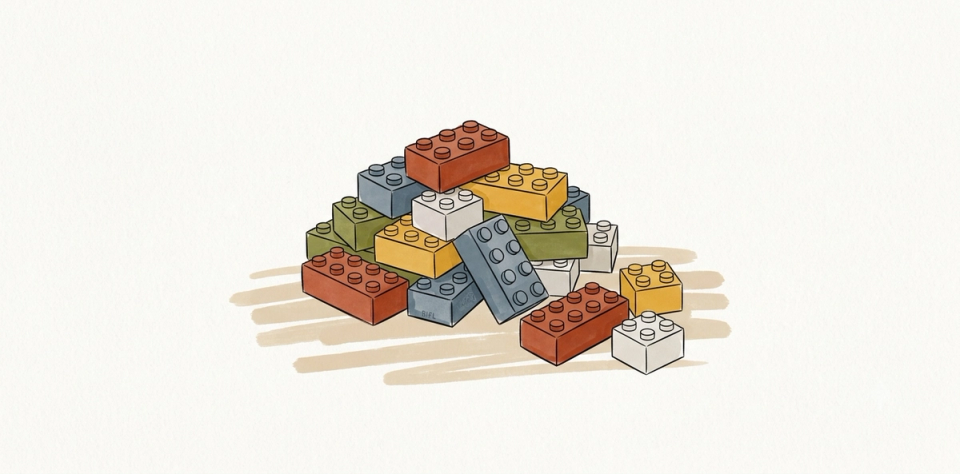
Why I take LEGO Classic bricks seriously as a lifetime purchase
I'm skeptical of toys that call themselves 'timeless.' But LEGO is one of the rare cases where that word carries actual weight. The bricks I had in the nineties still connect to the ones my kids buy today. That's not a marketing claim: a documented, verifiable technical fact, sustained across sixty-five years.
This review isn't just about the LEGO Classic Colorful Creative Bricks set (11045, 820 pieces, €39.99 at bol.com). That set is an entry point. The real question is whether the system LEGO represents makes sense as a buy-once, use-forever investment.
My answer is yes, with a few honest caveats.
Material and build quality
LEGO bricks are manufactured from ABS plastic (acrylonitrile butadiene styrene). The choice is deliberate: ABS is rigid, impact-resistant, dimensionally stable under temperature variation, and holds color significantly better than the cheaper polypropylene used by budget competitors. The tolerances LEGO maintains in its injection molding process are, by industrial standards, exceptional - coupling precision is controlled to within a few hundredths of a millimeter.
You feel it in the click. A LEGO brick connects differently from an Action store clone or a generic building block set. That tactile difference isn't cosmetic. It's the result of decades of process refinement. Cheap alternatives like the Abrick sets from Action (~€7.95 for 70 pieces) fit looser, deform faster, and show visible degradation within three to seven years. LEGO bricks do not.
Laboratory testing shows a LEGO stud-and-tube connection withstands more than 37,000 coupling cycles before measurable degradation. For a child building daily, that's roughly forty years of use. For an adult collector, longer still.
Longevity and compatibility: the real argument for lego classic bricks lifetime value
The first LEGO brick was patented in 1958. A brick from that year connects to one from set 11045 today. That's not accidental - LEGO maintains a strict internal standard: new sets must remain compatible with everything ever produced under the system.
This is what separates LEGO from nearly every other toy. A Fisher-Price toy from 1985 is a relic. A LEGO set from 1985 is still usable. The value of the bricks doesn't degrade because the system ages - it grows, because the ecosystem expands.
For parents, this means bricks bought today can be combined with sets purchased a decade from now. Nothing becomes obsolete. Nothing ends up in landfill prematurely because the system moved on without it.
Repairability: Pick a Brick and Bricks & Pieces
An underappreciated advantage of LEGO is individual part replacement. Through LEGO's Pick a Brick service, you can order individual bricks by color, size, and type. Lose a critical piece? Replace the brick, not the set.
LEGO also runs a 'Bricks & Pieces' customer service channel where missing or damaged parts from sets can be requested - sometimes at no cost. That service level is rare for consumer toys at any price point.
This makes LEGO not just durable in the sense of lasting a long time, but genuinely repairable, which places it in a completely different category from disposable products.
Sustainability: an honest picture
LEGO is working toward a material transition: as of 2025, approximately 52% of materials used are recycled or renewable in origin. Their stated target is 100% before 2032. That's ambitious, and so far LEGO has not missed its interim milestones. Biobased polyethylene is already in use for flexible elements like plant parts and leaves.
But to be direct: the core structural bricks - the studs, the tubes, the standard 2x4s - remain primarily virgin ABS. Fully recycled ABS that meets the same dimensional tolerances does not yet exist at industrial scale without quality compromise. LEGO is making the right call in prioritizing quality assurance over a green label that would degrade performance.
A brick that lasts sixty years is, by any reasonable measure, more sustainable than ten cheaper bricks that don't - regardless of the feedstock.
Honest downsides: price per brick
Set 11045 costs €39.99 for 820 bricks - roughly €0.049 per piece. The Action Abrick set comes in at €7.95 for 70 pieces - €0.11 per brick - but that comparison is misleading: those bricks degrade faster, carry no cross-compatibility, and have no secondary market.
Still: LEGO is expensive. For budget-constrained households, the entry price is a real barrier. The cheapest new option for bulk bricks still runs into tens of euros. Secondhand LEGO - via BrickLink, eBay, or local marketplaces - is a serious alternative. The quality is identical to new, and you pay less. The fact that secondhand LEGO holds its value well is itself evidence of the BIFL case: the market prices these bricks as if they were new.
A second honest downside: themed sets (Harry Potter, Star Wars, Technic) cost significantly more per brick than Classic sets. If loose bricks for free-form building are the goal, Classic or Bulk Bricks is the most cost-efficient route into the system.
Final verdict
LEGO Classic bricks - and the LEGO system as a whole - is one of the few toy categories I recommend without hesitation as a genuine lifetime purchase.
What works: sixty-five years of proven technical precision, universal backward compatibility, active part-replacement services, strong resale value, real repairability through Pick a Brick.
What doesn't: high entry price for new sets, ABS is not yet fully sustainable at scale, themed sets create pressure to keep buying rather than build with what you have.
BIFL verdict: A strong buy for anyone willing to invest once in a system that survives generations. Buy Classic for loose bricks, buy secondhand if budget is a constraint, and combine freely - the system is designed to never leave you behind.