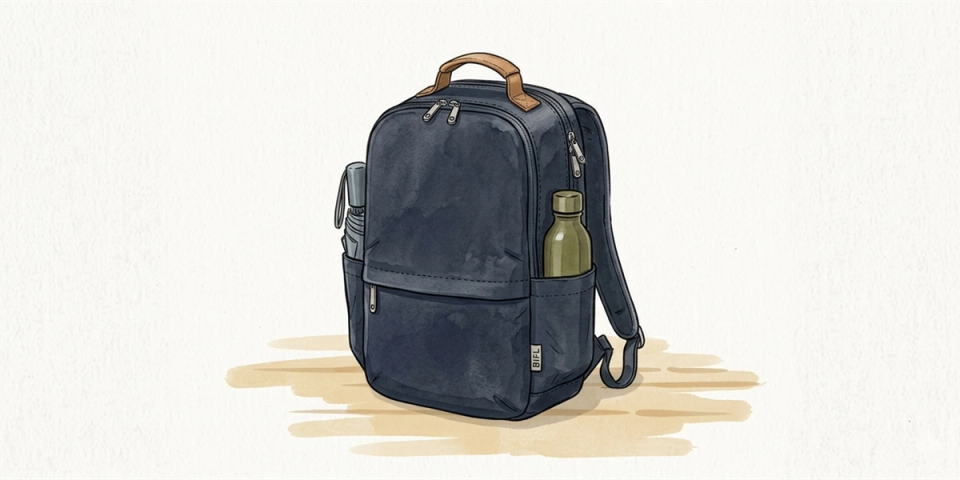
My Dakine Campus 25L from 2018 got many things right. Its size worked for a daily commute, the organization was practical, and it looked restrained enough for the office. The inner coating only started to deteriorate visibly in 2025. The lower corners were wearing too. That means it gave me about seven years of intensive use before the first clear material problems appeared. I do not consider it a failed bag, but the wear explains why I wanted to try a different material approach this time.
The replacement did not need to be an exciting outdoor pack. I wanted the same everyday usefulness, but with a material that could be maintained and without another hidden coating that might eventually flake away.
The requirements were unusually specific
A backpack can be strong on paper and still fail on one detail. For me, the side pockets, laptop dimensions, and appearance were requirements rather than preferences.
- Roughly 23 to 28 litres, close to the old Dakine at about 47 by 30 by 18 centimetres.
- Room for a 37 by 26 centimetre laptop, preferably in a separate protected compartment.
- Two usable external pockets: one for a full Dopper bottle and one for an umbrella, ultimately a Davek Solo.
- Enough protection for about fifteen minutes of heavy rain, without pretending the bag is fully waterproof.
- Hard-wearing fabric, reliable zips, and a plausible route for maintenance or repair.
- A conventional zip opening and an office-appropriate shape. No roll-top, front bungee, or overtly outdoorsy styling.
That last point mattered more than I expected. The North Face Borealis and Fjällräven Skule are functional, but their front bungees look too sporty to me. The Patagonia Black Hole 25 has two useful side pockets, yet the daisy chains create exactly the outdoor look I did not want at work.
Why the Fjällräven Räven 28 won
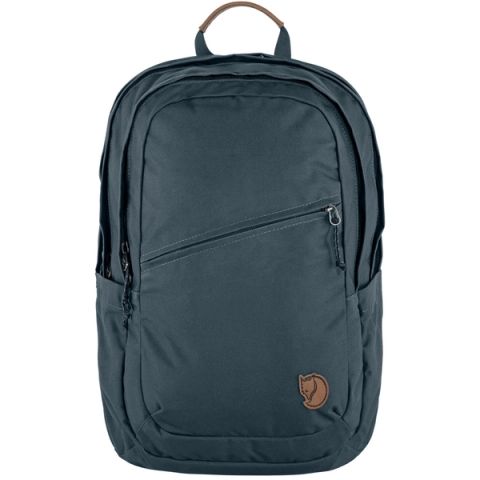
The official specifications come unusually close to my brief: 28 litres, 47 by 31 by 21 centimetres, a laptop compartment rated for devices up to 43 by 27 centimetres, and two open side pockets. It weighs about 1 kilogram. That is not light, but it is acceptable for the structured organization.
The combination settled it. Many alternatives offered two side pockets, an office-friendly shape, or a roomy laptop compartment. The Räven combined all three without a roll-top or elastic webbing across the front.
G-1000 HeavyDuty is not waterproof. Its advantage is that the water resistance can be maintained with Greenland Wax. That makes more sense to me than depending on another internal coating whose weakness may only appear years later.
What I have actually checked
I have bought the Räven 28, but I have not used it in daily life yet. My 37 by 26 centimetre laptop fit properly in the laptop compartment. A full Dopper and a different umbrella also fit in the two side pockets at the same time.
That is a useful fit check, not a long-term test. I cannot yet make first-hand claims about all-day comfort, cycling in rain, bottom wear, or how well the pack keeps its shape after a year. I have not physically tested the Davek Solo in the side pocket.
The objections to the Räven 28 are real
This is a personal choice, not a universal win. The non-elastic side pockets are roomy, but a narrow bottle can slide out when you bend over. Many owners say the bag does not stand easily on its own. There is no sternum strap or hip belt either.
Reddit owners disagree about the back panel and shoulder straps. One detailed review likes the organization and space but calls the straps firm and the balance poor. Another owner found the back panel very sweaty during a warm city day and had marks from the straps. A third buyer had no trouble keeping a full-size Hydro Flask in place, but still missed a sternum strap on longer days. Those differences are why I want to revisit the bag after real use.
The warranty is not a decisive reason to choose Fjällräven. Its statutory warranty period depends on your country. Osprey offers a much longer European guarantee period. Anyone who values warranty cover more than appearance can reasonably reach a different conclusion.
The best alternatives for slightly different needs
The closest matches to my requirements
| Feature | Capacity | Side pockets | Reason to choose it | Why I did not |
|---|---|---|---|---|
| Fjällräven Räven 28 | 28 L | Two open pockets | Office-friendly shape, organization, waxable fabric | 1 kg, no sternum strap, not waterproof |
| Fjällräven Ulvö 23 | 23 L | Two stretch pockets | Lighter and better rain resistance | Official laptop width is 25 cm; mine is 26 cm |
| Thule Chasm 26 | 26 L | One expandable pocket | Strong 900D fabric and a clean silhouette | One side pocket is not enough for me |
| Thule EnRoute 26 | 26 L | Two mesh pockets | Laptop dimensions and side pockets fit the brief | Compression straps look slightly sportier |
| Osprey Metron 24 | 24 L | Practical external storage | Rain cover and long guarantee | More of a cycling and sports pack |
| The North Face Borealis | 28 L | Two bottle pockets | Proven organization and carry system | Front bungee |
| Patagonia Black Hole 25 | 25 L | Two stretch pockets | Light and weather resistant | Daisy chains and a look I find too sporty |
| Aer City Pack Pro 2 | 24 L | Two bottle pockets | Clean office look and good laptop storage | Heavier and expensive after import |
| Evergoods CTB26 | 26 L | Two stretch pockets | Deep organization and lifetime warranty | About 1.6 kg empty |
| Gregory Rhune 25 | 25 L | One stretch pocket | Restrained look and limited lifetime warranty | Only one side pocket |
Fjällräven Ulvö 23: choose it for lower weight and more rain margin
The Ulvö 23 weighs about 650 grams and uses waterproof Bergshell fabric. It has two stretch side pockets and is only 12.5 centimetres deep. The official laptop compartment is 43 by 25 centimetres. My laptop is 26 centimetres wide, so this otherwise attractive option became uncertain at the most important point.
Thule Chasm 26 and EnRoute 26: one side pocket or two
The Thule Chasm 26 makes sense if one large side pocket is enough. Its 900D fabric and clean front work in its favour, but I wanted to keep my bottle and umbrella separate. The Thule EnRoute 26 has two mesh pockets and a laptop compartment officially rated at 26.5 centimetres wide. Its compression straps add function, but also make the bag look busier.
Osprey: the rational choice when warranty comes first
Osprey advertises a 30-year All Mighty Guarantee in Europe, subject to its terms and exclusions. The Metron 24 also includes a rain cover. The Astronova 23 is lighter and has two bottle pockets. Both look more like sports or cycling packs to me. Osprey can be the better answer for someone who values warranty and ventilation over a restrained appearance.
Borealis and Patagonia: functional, but visibly sporty
The Borealis offers 28 litres, two bottle pockets, and a dedicated laptop compartment. Its front bungee was a clear deal-breaker for me. The Patagonia Black Hole 25 is light, weather resistant, and has two stretch pockets. I simply do not like it enough for the office. The front daisy chain makes it look a little too sporty.
Aer and Evergoods: cleaner, but heavy and expensive
The Aer City Pack Pro 2 has the clean office look I wanted, two bottle pockets, and a padded laptop compartment. The Evergoods CTB26 adds more organization and a lifetime warranty. At roughly 1,587 grams, the Evergoods is much heavier than the Räven before it is packed. Price and import costs matter for both.
Dakine Campus 25: the familiar low-cost route
The current Dakine Campus 25 remains close to the size that worked for me. Its listed lining still includes PVC. After watching the inner layer of my old bag crumble, I wanted to try a different material approach. That does not make the Dakine a bad bag, but it made buying the same idea again less attractive.
The complete longlist with affiliate links
Not every bag below is a direct Räven 28 competitor. Some dropped out early because of their size, a roll-top, a single side pocket, weight, price, or a technical appearance. The links open a search result because colours and exact variants change. Check the model before ordering.
- Dakine Campus 25L: Search at Amazon
- Fjällräven Ulvö 23: Search at Amazon
- Fjällräven Skule 28: Search at Amazon
- The North Face Borealis 28: Search at Amazon
- The North Face Vault: Search at Amazon
- Thule Chasm 26: Search at Amazon
- Thule EnRoute 23: Search at Amazon
- Thule EnRoute 26: Search at Amazon
- Thule Indago 23: Search at Amazon
- Deuter Cotogy: Search at Amazon
- Deuter Giga: Search at Amazon
- Osprey Astronova 23: Search at Amazon
- Osprey Metron 24: Search at Amazon
- Patagonia Black Hole 25: Search at Amazon
- Patagonia Refugio 26: Search at Amazon
- Arc'teryx Mantis 26: Search at Amazon
- Aer City Pack Pro 2 24L: Search at Amazon
- Evergoods CTB26: Search at Amazon
- Mystery Ranch District 24: Search at Amazon
- Gregory Rhune 25: Search at Amazon
- Bellroy Transit Workpack: Search at Amazon
- Vaude Mineo 23: Search at Amazon
- Topo Designs Rover Pack Tech: Search at Amazon
Also considered, but eliminated earlier
- Fjällräven Ulvö 30 Rolltop: Search at Amazon
- Thule Crossover 2 30L: Search at Amazon
- Thule Paramount 27L: Search at Amazon
- Thule EnRoute 30L: Search at Amazon
- Osprey Metron WP 25: Search at Amazon
- Osprey Nebula 32: Search at Amazon
- Osprey Quasar 26: Search at Amazon
- Peak Design Travel Backpack 30L: Search at Amazon
- Peak Design Everyday Backpack 20L: Search at Amazon
- Ortlieb Commuter-Daypack 27L: Search at Amazon
- Ortlieb Commuter-Daypack 23L: Search at Amazon
- Ortlieb Atrack 34L: Search at Amazon
- Stubble & Co Roll Top 30L: Search at Amazon
- RED Original Waterproof Backpack 30L: Search at Amazon
- YETI Panga 28: Search at Amazon
- AquaQuest waterproof backpack: Search at Amazon
- Arc'teryx Granville 25: Search at Amazon
- Able Carry Daybreaker 2: Search at Amazon
- Able Carry Max: Search at Amazon
- Chrome Urban Ex: Search at Amazon
- Chrome Hawes 26L: Search at Amazon
- Timbuk2 Authority Laptop Backpack Deluxe: Search at Amazon
- GORUCK GR1 26L: Search at Amazon
- Tom Bihn Synik 26: Search at Amazon
- Cotopaxi Allpa 28L: Search at Amazon
My provisional conclusion
The Fjällräven Räven 28 is the best match for me because it combines two real side pockets, a laptop compartment that fits, and a restrained office look. It is not the lightest or most waterproof option, and it certainly does not have the strongest warranty.
The purchase is therefore not the final verdict. It is the result of a focused selection and an initial fit check. After a period of daily use, I want to update this article with carrying and rain experience, plus photographs of both the new Räven and the wear on the old Dakine.